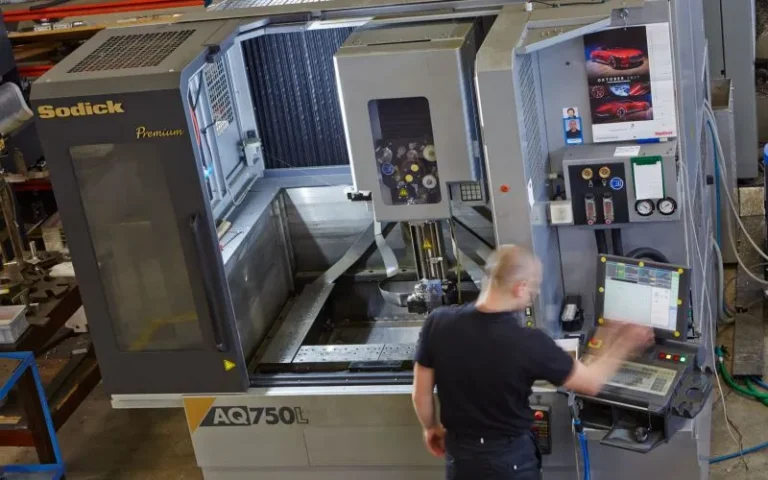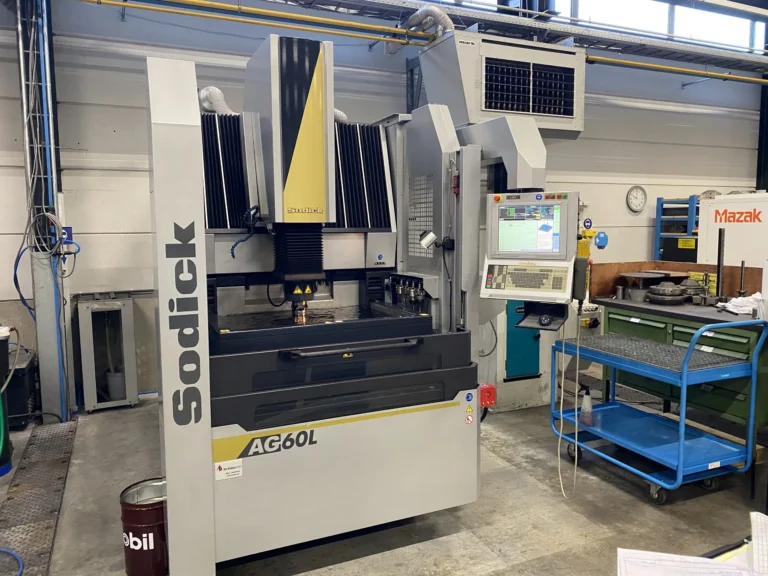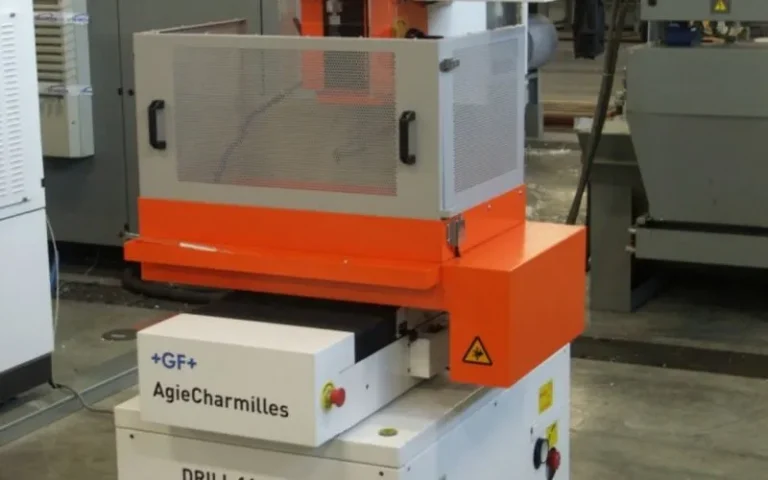
Wire EDM and die-sinking EDM are non-cutting machining techniques with which Diametal in Herentals, province of Antwerp, machines parts that require very high accuracy and/or are not possible with more traditional machining methods such as turning and milling.
We typically use wire EDM and die-sinking EDM to finish hardened parts and for operations such as sharp inside corners, square holes, all kinds of gearing, (multiple) keyways and cutting through workpieces. Because of the precision it achieves, wire or die-sinking EDM lends itself extremely well to machining your workpieces at micron level.
Using wire EDM or die-sinking EDM offers you the following advantages:
• High accuracy
• No mechanical load
• Extremely complex shapes that are not possible with milling and turning
• Wire and die-sinking EDM work equally well on unhardened and hardened material
As you can see, you will certainly benefit from the process of wire EDM and die-sinking EDM, techniques that you can have carried out by our experts. The same goes if you are looking for a professional to, for example, CMM measure and other services.
Besides CNC turning and CNC milling, Diametal has also built up a specialisation in wire EDM and die-sinking EDM. These 2 techniques complement CNC turning and CNC milling. Although wire EDM and die-sinking EDM rely on the same technology, they are very different from each other, and the two techniques can also give different finishes.
Wire EDM and die-sinking EDM are not cutting operations (they create no chips) but a technique based on spark erosion. You create a voltage difference between the workpiece and an electrode, which produces an arc that can cut through (wire EDM) or into (die-sinking EDM) electrically conductive material. What matters is the correct distance between the workpiece and the electrode, so that an arc actually jumps across and no short circuit occurs. The arc itself takes place in a continuously cooled and filtered dielectric, which at Diametal is demineralised water. With both wire EDM and die-sinking EDM it is possible to produce the most complex shapes in conductive materials (usually metal) with the highest accuracy. But the biggest advantage of wire EDM and die-sinking EDM compared to CNC turning and CNC milling is that they can also handle shapes that cannot, or only with great difficulty, be turned or milled, such as square holes (through or blind), sharp inside corners, right-angled inside holes, … In addition, hardened and tough materials can be machined with the same ease.
Wire EDM is done with a wire that is continuously renewed. The wire itself is usually a brass alloy 0.25 mm thick. This wire cuts through the metal in a straight movement, whether or not at an angle or with a different top and bottom contour. Thanks to the constant wire thickness, the smallest radii and shapes can be machined with the highest accuracy. By re-cutting the same contour with different settings in 1, 2 or 3 wire passes, tolerances of up to 0.003 mm and a roughness of up to 0.1 µm can be achieved. The speed of wire EDM depends strongly on the height of the workpiece and the desired degree of finish. Wire EDM is an extremely precise technology with only 1 drawback (just like die-sinking EDM): it is slow.
In die-sinking EDM, electrodes are used, often in copper, sometimes also in graphite. At Diametal these are milled on our CNC milling machines. These electrodes “sink” into the metal workpiece, so that the shape of the electrode is stamped into the part. Hence the name die-sinking. For an accurate finish several electrodes are used, because the electrode always wears through the spark erosion. In die-sinking EDM a spark texture can also be applied to the machined surface. This technique is often used for plastic moulds.
The wire EDM and die-sinking EDM machines and the required electrodes are programmed using CAD-CAM software. Although wire and die-sinking EDM is a slow operation compared with CNC turning and CNC milling, it can easily run unmanned. The operator only has to set up and start the machines for wire and die-sinking EDM. Once the operation has started, the machines can continue fully unmanned for hours and sometimes even days.
Good work preparation, knowledge of spark erosion and of other mechanical operations is necessary to use wire EDM and die-sinking EDM successfully. Diametal has been working with spark erosion for more than 15 years and has built up extensive experience in it.
Wire EDM and die-sinking EDM are non-cutting machining techniques based on spark erosion. A voltage difference between the workpiece and an electrode produces an arc with which electrically conductive materials can be machined very accurately.
In wire EDM, a continuously renewed wire is used that cuts through the metal. In die-sinking EDM, an electrode, often made of copper and sometimes of graphite, is “sunk” into the workpiece, so that the shape of the electrode is applied to the part.
By re-cutting the same contour in several wire passes, according to Diametal tolerances of up to 0.003 mm and a roughness of up to 0.1 µm can be achieved. This makes wire EDM suitable for very accurate machining.
With wire EDM and die-sinking EDM, complex shapes can be made that are difficult or impossible to achieve with CNC turning or CNC milling, such as square holes, sharp inside corners, right-angled inside holes, gearing and keyways. Both unhardened and hardened electrically conductive materials can be machined.
The main advantages are high accuracy, no mechanical load on the workpiece and the ability to make extremely complex shapes. Hardened and tough materials can also be machined accurately with these techniques.